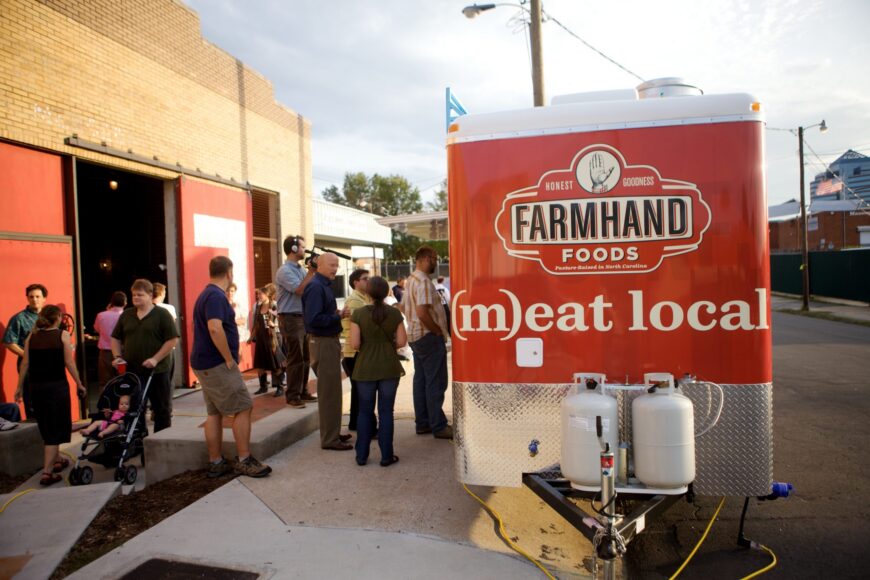
Knowing where your meat comes from has always been the heart of our businss, and last week a customer reminded us how far back that story goes. When they placed a Meat Box order, they sent us a note: “I still have a coupon for $25 off from Farmhand Foods. Is that your company?” It is! We were amazed that someone had held on to that coupon for 13 years, and it reminded us that it’s time to tell the story of our name again.
We started out in 2010 as Farmhand Foods, selling sausage around Durham from a food truck we called the Sausage Wagon. About a year in, we received a cease-and-desist letter from Smithfield Foods, which sells pork under its Farmland Foods brand, claiming our name could infringe on their trademark. Even though the U.S. Patent and Trademark Office granted us the rights to Farmhand Foods, trademark law requires companies to defend their marks, so we had a choice to make: spend money we didn’t have on legal fees, or change our name. We were a brand-new business with a lot to build, and a legal fight was not how we wanted to spend our time or our money. Jennifer’s husband came up with “Firsthand,” and it let us keep the hand in our award-winning logo. In the end, it turned out to be an even better fit.
“Firsthand” means knowing something directly, not through an intermediary or a label, and that’s how we’ve always tried to run this business. We buy animals directly from independent North Carolina farmers, coordinate the processing, and sell the fresh cuts to restaurants, retailers, and households. Because we know the people at every step, we can trace every cut back to the farm where the animal was raised.
Working firsthand means knowing people on a first-name basis all along the supply chain. We talk with our farmers about scheduling, and we tell them what our chefs are seeing in the meat so they can adjust how they raise their animals. We work side by side with the processors who cut and pack our product to our specifications. When a chef wants to try a new cut or a store needs more ground beef before a holiday weekend, they call someone they know. When something goes wrong, and in a business built on live animals it sometimes does, we pick up the phone and figure it out together.
Those relationships are the real value of what we do. Trust doesn’t come from a certification or a slogan. It comes from years of keeping our word to farmers who need a buyer they can count on, and to customers who want to know exactly what they’re serving. Being firsthand is what lets us say, with confidence, how your beef, pork, or lamb was raised: humanely, on pasture, by families who care about their land. It’s how we build community through food, and it’s what (m)eat local means to us.
And yes, we honored the coupon.